Executive Technical Whitepaper: The Paradigm Shift in Enterprise VR & AI Eyewear Supply Chains
The global market for Virtual Reality (VR), Augmented Reality (AR), and AI-assisted wearable smart glasses is undergoing a dramatic structural transformation. Transitioning from heavy, tethered visual display units to lightweight, sensor-fused spatial computing platforms, enterprise buyers require hardware suppliers who offer proven manufacturing engineering, rigorous optical calibration, and compliance with international bio-sensing standards.
As a leading original equipment manufacturer (OEM) and exporter, our engineering ecosystem bridges the critical gap between immersive display technology and affective computing. By capturing continuous, real-world human telemetry—including facial muscle activation, movement vectors, spatial elevation, and contextual visual streams—our smart eyewear platforms provide non-contact biofeedback without restricting user mobility or compromising privacy.
Key Market Drivers for Enterprise Procurement
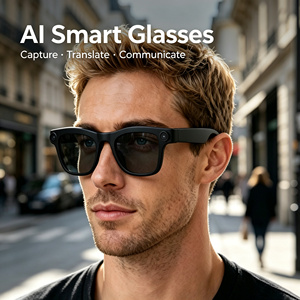
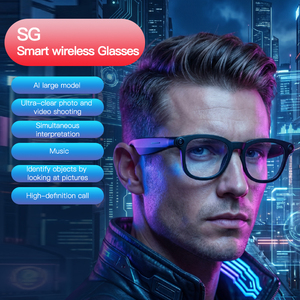
Convergence of LLM AI & Wearable Optics: Integration of on-device neural processing units (NPUs) with low-power optical engines allows real-time translation across 140+ languages and contextual image recognition.
Non-Contact Affective Bio-Sensing: Replacement of messy surface electrodes (sEMG) with optomyography (OMG) sensors capable of mapping facial micro-expressions without touching the skin.
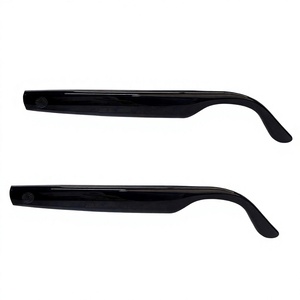
Form Factor Ergonomics: Reduction of total headset mass below 75 grams through titanium-silicone hybrid frames, optimized thermal dissipation, and split-battery temple designs.
At the core of our advanced manufacturing capabilities lies our patented OCO™ Optomyography (OMG) sensor technology. Traditional biometrical tracking in VR and spatial eyewear relied either on bulky inward-facing cameras that drain battery life and trigger data privacy concerns, or surface EMG gels that degrade during prolonged wear.
Our patented optical sensing architecture captures three-dimensional facial skin movement with sub-millimeter precision. By positioning miniature non-contact optical sensors along the frame's contact perimeter, our hardware records continuous facial muscle movement (such as zygomaticus and corrugator activity) to derive emotional valence, fatigue, chewing episodes, and cognitive engagement.
Patented OCO™ OMG Sensors
Non-contact optical skin movement detection capable of isolated 3D mapping of facial expressions without gel, adhesives, or facial cameras.
Integrated 9-Axis IMU & Altimeter
High-frequency inertial measurement units coupled with micro-altimeters measure head movement, postural stability, and fine physical movement vectors.
Context-Aware Outward Camera
Ultra-low-power first-person scene camera synchronizes environmental visual context with biological signals for precise data tagging.
Edge-AI Signal Processing
On-device machine learning models process raw optical signals locally, streaming interpreted metrics while safeguarding user privacy.
Our hardware and software stack is backed by robust global patent protection, ensuring that enterprise B2B procurement partners receive proprietary technology protected against regional IP infringements:
United States Patents: US 11,003,899 (Optomyographic Sensing Systems) & US 11,538,279 (Wearable Affective Computing Eyewear Architecture).
For enterprise purchasing directors, supply chain managers, and OEM project leaders, selecting a VR and AI smart glasses supplier requires evaluating multi-year technology roadmaps. Over the next five years, procurement decisions will be guided by five critical hardware vectors:
1. Transition from Standalone VR Displays to All-Day Wearable Spatial Frames
The enterprise sector is rapidly moving away from heavy VR headsets restricted to desk setups or specialized VR chambers. Demand is shifting toward lightweight smart glasses capable of switching dynamically between transparent augmented reality, voice-activated AI translation, and silent physiological monitoring. High-yield suppliers must offer versatile frames suitable for industrial field inspections, medical rehabilitation, and continuous consumer behavioral studies.
2. Open SDK Ecosystems & Edge API Interoperability
Lock-in proprietary software ecosystems represent a major risk for enterprise buyers. Modern procurement mandates hardware platforms equipped with open Software Development Kits (SDKs), supporting real-time data streaming via Bluetooth 5.3, Wi-Fi 6, and local API hooks. This allows enterprise engineering teams to integrate custom biometric analytics, internal LLMs, or proprietary clinical dashboards directly on top of raw sensor outputs.
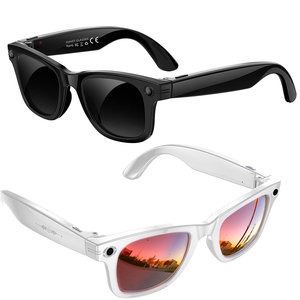
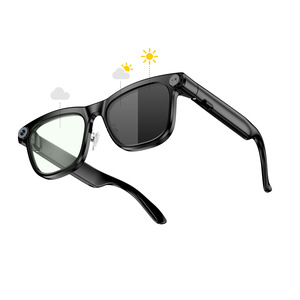
Corporate buyers require tailor-made hardware adjustments—such as optical prescription inserts, customized acoustic wave guides, interchangeable polarized lenses, or specialized frame colorways (e.g., Pearl Beige, Matte Carbon). Factories capable of modular assembly allow B2B clients to scale from pilot batches (500 units) to mass production (100,000+ units) without redesigning basic PCB circuit boards.
4. Strict Compliance with Data Privacy & Biometric Regulations
With the global enforcement of strict data privacy laws (GDPR, HIPAA, and CCPA), spatial hardware must process sensitive biometric data at the device edge. Hardware featuring local optical signal processing ensures that raw video or muscle activation signals never leave the physical device without explicit end-user authorization.
Evaluation Parameter
Legacy VR / Camera-Based Eyewear
Our Next-Gen AI & OCO™ Smart Eyewear
Facial Sensing Method
Inward RGB cameras or sticky sEMG gel pads
Non-contact 3D Optomyography (OCO™ OMG)
Power Consumption & Thermal
High (Camera processing causes frame heat)
Ultra-Low (<0.8W active biosensing payload)
Daylight & Outdoor Usability
Poor (Direct sun washes out camera tracking)
100% Operational (Optical infrared skin sensing)
Data Privacy Architecture
Continuous video streaming of user's face
On-device edge metric calculation & local processing
Industry Development Trends: Engineering Breakthroughs in Wearable Hardware
The smart eyewear and VR export market is entering a era of technological convergence. Suppliers who fail to innovate across optics, audio, and biometrics will quickly be left behind. As a forward-thinking exporter, our R&D engineering program focuses on four primary technology vectors:
The display subsystem is evolving from bulky LCD projection units toward high-transmittance optical waveguides paired with Micro-OLED displays. Providing over 3,000 nits of peak brightness, these optical engines allow AR overlay graphics—such as live translation subtitles, turn-by-turn navigation graphics, or real-time biofeedback stats—to remain visible even under direct sunlight.
Modern users reject noise-isolating earbuds for all-day smart glasses. Our custom frames integrate 13mm directional dynamic drivers into the eyewear temples. Using acoustic phase cancellation, sound is directed precisely into the user's ear canal while preventing sound leakage to adjacent individuals. Coupled with dual noise-canceling MEMS microphones, clear voice capture is guaranteed even in noisy outdoor environments.
3. Multimodal Voice, Gesture, and Fingerprint Touch Control
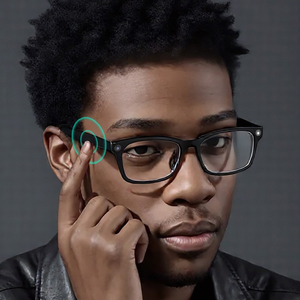
Human-computer interaction (HCI) is shifting toward seamless multimodal inputs. Our frames combine capacitive fingerprint touch sliders on the eyewear temples, hands-free offline wake-word recognition ("Hey AI"), and subtle facial gestures (such as double-winks or jaw clenches captured via OMG sensors) to create an intuitive, hands-free operating system interface.
Operating continuous camera capture, wireless audio streaming, and optical sensor polling generates localized heat. Our hardware utilizes aerospace-grade titanium alloy hinges, TR90 memory polymers, and internal graphite heat spreaders. This ensures that temple temperatures never exceed 3.5°C above ambient room temperature during continuous operation.
Enterprise Procurement & Technical FAQ
Below are authoritative answers to common questions raised by enterprise procurement officers, technical buyers, and OEM partners when selecting VR and AI smart glasses suppliers:
What is the difference between OCO™ Optomyography (OMG) and standard camera facial tracking?
OCO™ optomyography measures facial skin movement optically without placing electrodes on the skin and without training a camera at the user's face. Unlike inward cameras, OMG works reliably in direct daylight, requires up to 80% less battery power, keeps raw biometrics on-device for total user privacy, and does not suffer from optical occlusions caused by prescription lenses.
What telemetry data streams can our enterprise applications access via your SDK?
Our open API and mobile SDK deliver time-synchronized data streams including: 3D facial muscle activation metrics, valence/emotional indicators, chewing/eating event detection, 9-axis IMU head rotation/acceleration vectors, barometric elevation shifts, first-person visual context video frames, and manual event timestamp annotations.
What are your typical Minimum Order Quantities (MOQ) and sample evaluation lead times?
Standard evaluation developer kits (1 to 10 units) ship within 3 to 5 business days for initial R&D assessment. For custom OEM/ODM production runs (involving custom logo printing, firmware localization, or specialized packaging), our baseline MOQ starts at 500 units, with typical production lead times ranging between 3 to 5 weeks.
Are your smart glasses fully certified for international export into North America and Europe?
Yes. All export production models hold full European CE marks, FCC Part 15 subpart B compliance, RoHS 2.0 hazardous material clearance, WEEE recycling registry, and UN38.3 lithium battery air travel certification. Complete compliance documentation is provided with every shipment.
Can prescription optical lenses be integrated into your smart glasses frames?
Yes. Our frame designs accommodate prescription lens inserts across a wide range of corrective needs (-8.00D to +4.00D). Optical inserts lock securely into internal frame slots without disturbing the OCO™ sensor array or outer protective lenses.
Partner with a World-Class VR & AI Eyewear Exporter
Whether you require evaluation samples for clinical R&D, customized OEM smart glasses for tourism deployment, or bulk production of high-yield AI translation eyewear, our engineering team is ready to support your technical specifications.