Executive Summary: The Strategic Evolution of Chinese Smart Eyewear Manufacturing
The global wearable technology ecosystem is undergoing a fundamental structural transition. Driven by the convergence of miniaturized optoelectronics, edge artificial intelligence, micro-display optics, and spatial computing, smart glasses are rapidly evolving from niche gadgetry into primary human-computer interfaces. As the world’s undisputed epicenter for hardware prototyping, component sourcing, and high-volume precision assembly, China wholesale smart eyewear factories and exporters occupy a pivotal position in this global hardware supply chain.
This whitepaper provides procurement directors, product managers, consumer electronics importers, and enterprise OEM buyers with an authoritative analysis of the Chinese smart eyewear manufacturing landscape. Moving beyond conventional OEM assembly, advanced manufacturers in technology hubs such as Shenzhen, Dongguan, and Wenzhou have integrated end-to-end design capabilities—spanning Surface Mount Technology (SMT) for ultra-compact PCBs, custom optical waveguide bonding, acoustic wave-guide engineering, and proprietary firmware development for multi-modal Large Language Model (LLM) integration.
Key Industry Paradigm Shifts & Technological Architectures (2025–2030)
To successfully navigate sourcing decisions, global buyers must evaluate smart eyewear suppliers across three primary technological paradigms that currently govern product development across Chinese OEM/ODM ecosystems:
1. Acoustic & AI-Voice Smart Sunglasses
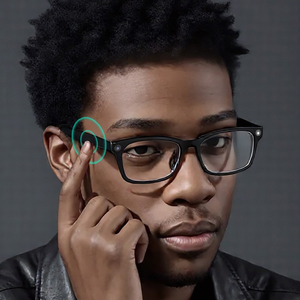
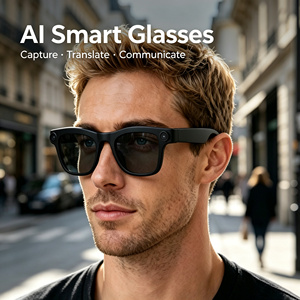
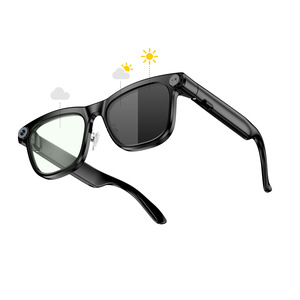
Representing the highest volume in current wholesale exports, open-ear directional audio eyewear utilizes micro dual-speaker arrays (typically 13mm to 15mm drivers) coupled with dual-microphone Environmental Noise Cancellation (ENC). Integrating low-power Bluetooth 5.3 SoC chipsets (such as Qualcomm QCC or Bestechnic BES series), these models deliver real-time voice-assistant access, hands-free calling, and cloud-tethered translation.
2. Visual AI & First-Person Capture Glasses
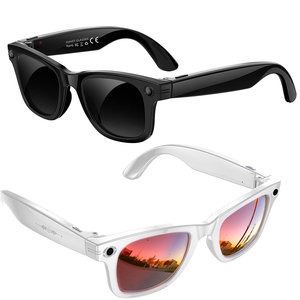
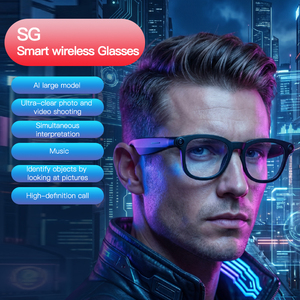
Integrating miniaturized CMOS camera modules (ranging from 5MP up to 13MP 4K with Electronic Image Stabilization), these wearables allow continuous visual logging and video recording. Advanced Chinese exporters combine camera sensors with edge AI algorithms capable of real-time object recognition, optical character recognition (OCR) text translation, and contextual scene comprehension synced to mobile LLM apps.
3. Monocular & Binocular Optical AR Displays
Positioned at the apex of hardware complexity, optical Augmented Reality glasses combine Micro-OLED or Micro-LED engines with Diffractive Optical Waveguides (surface relief or holographic). These systems project transparent heads-up navigation, real-time teleprompter text, or complex AR industrial overlays directly into the user’s line of sight without obscuring ambient vision.
Comparative Hardware Matrix for B2B Procurement
When selecting product lines for regional distribution or private-label launching, enterprise buyers must evaluate the tradeoffs between battery endurance, thermal dissipation, mass weight, and unit BOM (Bill of Materials) costs:
| Category Tier | Primary Chipset Architecture | Display / Camera Specs | Average Battery Life | Target B2B Wholesale Application |
|---|---|---|---|---|
| Audio AI Sunglasses | Qualcomm QCC3040 / BES2500 | N/A (Tactile Touch / Fingerprint) | 6 – 10 Hours Active Audio | Lifestyle, Sports, Driving, Voice AI Access |
| Translation & Voice AI | BLE 5.3 + Dual MCU Core | Optional OCR Text Engine | 8 – 12 Hours Duty Cycle | Cross-Border Tourism, Business Meetings |
| 4K Vision AI Eyewear | Ambarella / Novatek High-Speed SoC | 13MP Sony IMX / 4K @ 30fps EIS | 70 – 120 Mins Continuous Capture | Vlogging, Inspection, First-Person Action |
| Optomyographic & Biometric | Proprietary Optical OMG / 9-Axis IMU | Context Dual-Cam + Facial Sensing | 4 – 8 Hours Real-Time Streaming | Clinical Research, XR Control, Health Analytics |
| Full Waveguide AR | Qualcomm Snapdragon AR1 Gen 1 / Micro-OLED | Diffractive Waveguide (640x480 to 1080p) | 2 – 4 Hours Active AR Display | Enterprise Logistics, Remote Maintenance, AR Navigation |
Emerging Technology: Non-Contact Facial Biofeedback & Optomyography (OMG)
A critical breakthrough shaping the top tier of wearable innovation is the integration of Optomyography (OMG) and multi-axis inertial sensing into smart eyewear frames. Pioneered for high-precision clinical research, healthcare analytics, and next-generation XR input, optical non-contact biofeedback sensors track subtle micro-movements of facial musculature without requiring conductive skin gel or restrictive facial cameras.
By capturing three-dimensional skin displacement around the zygomatic, temporalis, and forehead muscle groups, smart glasses equipped with OMG sensors yield continuous streams of physiological data. When combined with a 9-axis Inertial Measurement Unit (IMU) and altimeter, these wearables quantify:
- Valence & Emotional Expressivity: Measuring continuous subtle affect changes for clinical psychology and neuromarketing research.
- Mastication & Dietary Behavior: Tracking exact chewing episodes, eating frequency, and ingestion tempo for metabolic health monitoring.
- Cognitive Workload & Fatigue: Detecting blink rate, head posture degradation, and facial muscle tension during high-stress operational tasks.
- Hands-Free Gesture Control: Translating discreet facial muscle twitches (such as winking or jaw clenching) into execution commands for AR interfaces.
China Wholesale Manufacturing Ecosystem: OEM/ODM Engineering Capacities
The competitive advantage of leading Chinese smart glasses manufacturers stems from their dense vertical supply chain integration within Guangdong province. For enterprise procurement teams, understanding the factory production lifecycle is vital for ensuring high yield rates and regulatory compliance.
1. Micro-Optoelectronic Assembly & Dust-Free SMT
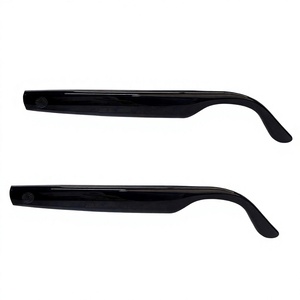
Smart eyewear frames demand sub-millimeter component placement. Top-tier factories utilize cleanrooms rated at Class 10,000 (ISO Class 7) or higher for optical alignment, lens bonding, and SMT processing of flexible printed circuits (FPC). Micro-speakers, MEMS dual-microphones, antenna coils, and capacitive touch sensors are mounted inside ultra-narrow frame temples without compromising structural integrity or aesthetic ergonomics.
2. Ergonomic Material Science & Thermal Management
Modern smart frames must balance durability, light weight, and heat dissipation. Leading Chinese exporters utilize Swiss EMS TR90 memory polymers, ultralight titanium alloys, and aerospace-grade aluminum. Internal thermal management strategies incorporate graphite heat-spreading sheets and high-conductivity copper traces to dissipate heat generated by camera processors or Bluetooth SoCs away from the user’s temporal bones.
3. Customized Firmware, SDK, and Cloud AI Translation Integration
Leading Chinese exporters do not merely deliver physical frames; they provide comprehensive software-hardware bundles. Proprietary Android/iOS SDKs enable global buyers to rebrand companion apps, integrate custom cloud endpoints (such as OpenAI GPT-4o, Google Gemini, or local Whisper translation microservices), and deploy custom firmware Over-The-Air (OTA).
Global Trade Compliance, Quality Control, and Certification Standards
Exporting high-tech optoelectronic wearables to North America, the European Union, and Asia-Pacific markets requires strict adherence to international safety, wireless, and optical regulations. Qualified Chinese manufacturers support buyers by providing full compliance documentation:
Wireless & EMC Directives
Full FCC Part 15 (USA), RED Directive 2014/53/EU (Europe), and TELEC (Japan) certifications guaranteeing safe Radio Frequency (RF) emissions, Bluetooth spectrum compliance, and electromagnetic compatibility.
Optical & Ocular Safety
ANSI Z80.3 and EN ISO 12312-1 optical standards for UV400 protection, polarized glare reduction, and IEC 62471 photobiological safety compliance for visual display components.
Environmental & Ingress Standards
RoHS 2.0 and REACH chemical safety testing, WEEE electronics recycling compliance, and certified ingress protection testing ranging from IP54 splash resistance to IP66 total dust/water jet resistance.